 Decisions, engineered.
Every enterprise
runs on decisions.
Most cannot see, govern or improve how those decisions are made.
Brillion helps organisations make consequential decisions visible, govern how they are made and connect each decision to the outcome it produces.
Decisions, engineered.decisions
Its decisions should be too.
Brillion is building the discipline, framework and operating system for enterprise decisions.
BRILLION / EDAF™ / DECISIONONEWhere enterprise decisions disappear from view.
Enterprises have systems for customers, finance, processes and data. The decisions connecting these systems often remain hidden, duplicated, inconsistent and difficult to govern.
Enterprise Decision Management
A management discipline and architecture for treating decisions as owned, governed, measurable and reusable enterprise assets.
DecisionOne adds a governed decision layer across ERP, CRM, BPM and data platforms. It does not replace them.
From dashboards
to decision loops.
A report describes the enterprise. A decision loop changes what the enterprise does next, then measures the result.
The framework for architecting enterprise judgement.
EDAF™ stands for Enterprise Decision Architecture Framework. It is Brillion’s technology-independent intellectual property for describing, governing and improving enterprise decisions.
EDAF™ is a Brillion trademark and Brillion-owned body of knowledge. It defines the discipline; DecisionOne implements it as an Enterprise Decision Operating System.
Turn hidden judgement into an explicit decision model.
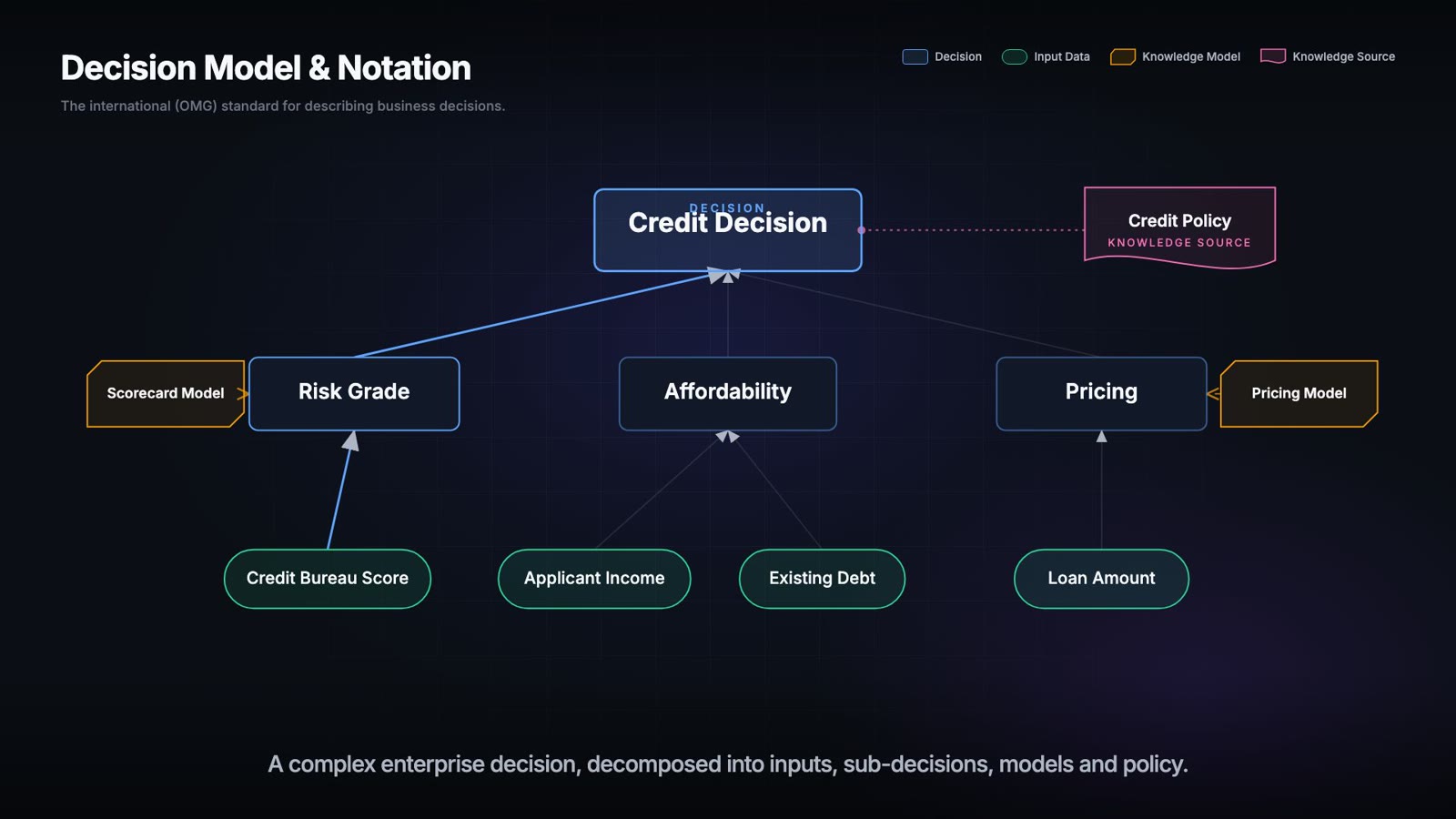
DMN specifies repeatable decision requirements and logic. EDAF™ describes the architecture around the decision. DecisionOne operationalises the complete lifecycle.
Capture improving demand without moving outside the market.
| Occupancy | Demand | Competitor | Decision |
|---|---|---|---|
| Low | Low | Below market | Hold or reduce |
| Medium | Rising | At market | Increase moderatelyRule fired |
| High | High | Above market | Optimise upward |
DecisionOne supports DMN where its semantics fit. EDAF™ also covers ownership, authority, objectives, outcomes, evidence and controlled improvement—the wider enterprise architecture of the decision.
OMG DMN 1.5 ↗One operating system for the complete decision lifecycle.
Turn policies, data, predictive models and human expertise into governed decision services that act, explain and learn.
 ▶Film · 02:32See the enterprise decision layer in motion.Watch the DecisionOne explainer ↗
Model a decision, test it and publish an approved version.
↗Decision RuntimeExecute rules, DMN, analytical models and human review.
↗Decision IntelligenceConnect each decision to its outcome and business impact.
↗DecisionOpsControl releases, overrides, drift and operating performance.
↗Decision MarketplaceReuse approved sector patterns, policies and connectors.
↗The same decision patterns occur in every industry.
A shared architecture, grounded in each operating context.
 HospitalityEvery room-night is a perishable decision.Explore pricing decisions ↗
 GovernmentPublic value depends on where scarce resources go next.Explore allocation decisions ↗
Coordinate rate, inventory, demand and intervention decisions across a hospitality portfolio.
Brillion is applying DecisionOne to hospitality revenue management, beginning with decisions such as room pricing, demand response and constrained inventory. Client names and results are published only with permission.
- Set the next best rate
- Accept a group request
- Allocate constrained inventory
| Decision domain | Hospitality | Outcome measured |
|---|---|---|
| Pricing | Room rates | Yield |
| Adjudication | Contract exceptions | Quality + consistency |
| Allocation | Rooms | Utilisation |
| Forecasting | Demand | Forecast accuracy |
Prediction can inform a decision. It cannot supply authority.
DecisionOne combines analytical outputs with policy, constraints, accountable review and a complete decision record.
Explore decision agents →Clearer systems for people who remain accountable.
Decision architecture does not remove people. It gives decision owners, reviewers and operators clearer authority, better evidence and a traceable basis for judgement.
Explore human and machine judgement →


Better decisions compound.
Business value becomes measurable when each outcome connects to the decision behaviour that produced it.
Pricing yield
Cost per decision
Loss and false-positive rate
Policy adherence
Decision latency
Outcome lift
EDAF™ requires each KPI to state its definition, unit, population, observation window and limitations. Decision debt and decision capital remain research constructs until their measurement methods are validated.