Editorial scene
EDAF™ · Enterprise Decision Architecture Framework

Decision Maturity Model

EDAF™ is Brillion’s defining, technology-independent framework for treating enterprise decisions as first-class architectural assets.

EDAF™ explained

EDAF™ stands for Enterprise Decision Architecture Framework. It is Brillion’s intellectual property and defining framework for how enterprises identify, architect, govern, engineer, operate, measure and improve decisions.

The EDAF™ point of view

Architecture for the judgement between information and action.

EDAF™ gives enterprises a technology-independent way to describe the decisions that connect intent, evidence, authority and outcomes.

EDAF™ is Brillion’s intellectual property and defining framework for Enterprise Decision Management. It supplies the vocabulary, principles, meta-model, reference views, lifecycle and governance concepts needed to treat decisions as part of enterprise architecture. The framework is deliberately broader than a rules engine or a modelling notation: it describes how a decision belongs to the enterprise, how it is governed and how its effects are observed over time.

The framework begins with a simple architectural observation. Information does not create business value by existing in a data platform; value is created when authorised people or systems use information to determine what should happen next. That determination is shaped by objectives, policy, risk appetite, constraints, models, available resources and human judgement. EDAF™ makes those relationships explicit so that a decision can be designed and discussed before it is embedded in a product or process.

EDAF™ is not a claim that every organisation must use one technology or one degree of automation. A decision may be implemented with rules, a DMN model, a predictive model, optimisation, a graph, a simulation, a human review or a combination of these mechanisms. The architecture remains useful because it records the purpose, authority, dependencies, evidence and outcomes independently of the implementation choice.


The framework connects levels of enterprise intent

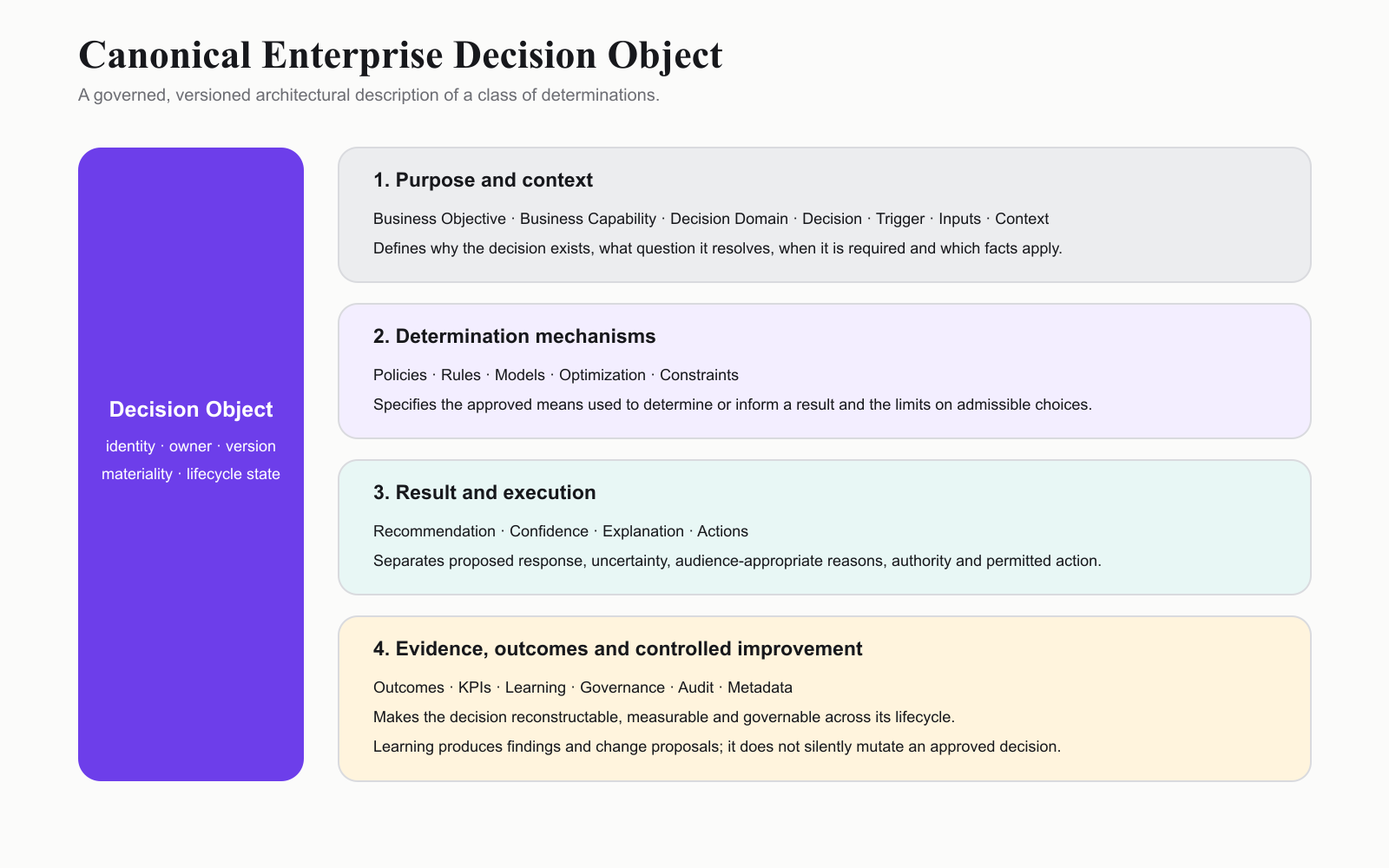
At the upper level, a business objective and capability explain why a decision exists. A decision domain groups related questions such as eligibility, pricing or allocation. An Enterprise Decision Object describes a governed class of determinations: its owner, objective, trigger, inputs, policies, rules, models, constraints, confidence, explanation, review path, action, outcomes, measures, feedback, version and audit evidence. A decision service then exposes the approved behaviour to the systems and people that need to use it.

This structure prevents two common errors. The first is to start with a technical component and call it the decision, even though the component has no clear owner, authority or outcome. The second is to write a policy document without defining how its intent becomes a repeatable service. EDAF™ holds the business and engineering views together without collapsing them into one artefact.

Governance is part of the architecture

A decision is consequential because it changes a case, a customer, a resource position or a future option. Its governance therefore cannot be added after deployment. EDAF™ treats approval, effective dates, test evidence, explanation, human review, audit, monitoring and retirement as architectural concerns. The lifecycle runs from discovery and modelling through validation, approval, publication, execution, observation, explanation, learning, improvement and retirement.

The current EDAF™ material is controlled alpha content. Brillion labels proposed principles and research constructs clearly so that readers can distinguish a framework definition from an externally verified standard. That editorial discipline is part of the framework’s purpose: an authority on decisions must make the status and limits of its own claims visible.

Controlled publication programmeVersion 0.1.0-alpha

No EDAF™ volume is yet designated as an approved standard. Alpha material is subject to architecture, evidence and editorial review.

01

Constitutional proposition

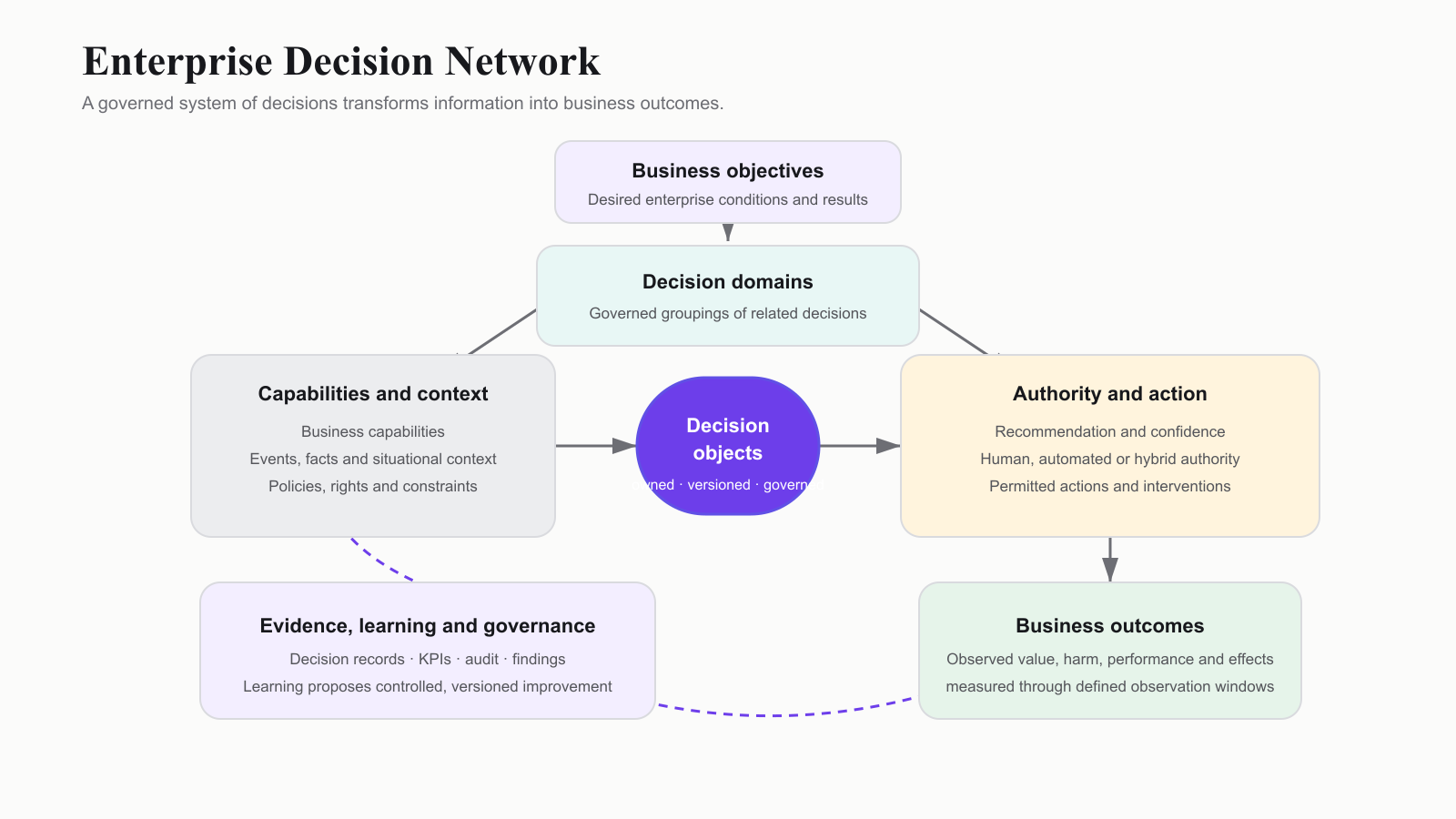
An enterprise is fundamentally a governed network of interconnected decisions that transform information into business outcomes.

This is an EDAF™ architectural premise. It is not presented as an empirically proven universal description of every organisation.

EDAF™-MK-ENTERPRISE-NETWORK

Decisions form a governed enterprise network.

Objectives, capabilities, domains, decision objects, authority, actions, outcomes and evidence belong in one coherent architecture.

Open the architecture library
EDAF™ Enterprise Decision Network reference model
02

Selected architecture principles

EDAF™-PRN-001Decisions form an enterprise network

Model dependencies, shared sub-decisions, authority and outcome effects.

EDAF™-PRN-002A decision is a first-class governed asset

Give every material decision an identity, owner, version and lifecycle.

EDAF™-PRN-004Decision, recommendation, authority and action are distinct

Preserve accountability even when execution is synchronous.

EDAF™-PRN-007Evidence is produced by design

Capture enough evidence to reconstruct, explain and assure a decision.

EDAF™-PRN-009Decisions are observable end to end

Observe trigger, result, action, outcome and improvement.

EDAF™-PRN-010Learning is controlled change

Learning proposes a change; it does not silently mutate approved logic.

Canonical EDAF™ Enterprise Decision Object showing purpose, mechanisms, results, evidence and governance
EDAF™-MM-001

The Enterprise Decision Object

A governed, versioned architectural description of a class of determinations. It connects purpose and context, determination mechanisms, authorised execution, outcomes, evidence and controlled improvement.

Explore every attribute
03

Lifecycle

01Discover
02Design
03Validate
04Approve
05Publish
06Execute
07Operationalise
08Monitor
09Learn
10Improve
11Retire
Enterprise Decision Maturity

From ad hoc judgement to governed autonomy.

Autonomy is the sixth stage, not the starting point. It requires observable decisions, bounded authority, evidence and controlled learning.

  1. 1Ad hoc
  2. 2Documented
  3. 3Managed
  4. 4Automated
  5. 5Optimised
  6. 6Autonomous
Next step

Make one consequential decision visible.

Book a Decision Discovery