Editorial scene
Why decisions

Decision Loops

Every enterprise depends on decisions, yet most manage the applications, data and processes around them more deliberately than the decisions themselves.

01

The starting proposition

A decision is a governed determination—not a prediction, workflow step or action.

Enterprise decisions resolve a defined question for a subject or case using applicable context and authority. Making that distinction explicit exposes who owns the decision, which mechanisms inform it, what may follow and how the outcome will be measured.

Reporting answers what happened. Decision assistance proposes what should happen. A governed decision loop authorises action, records why it happened and learns from the result.

Enterprise Decision Management

Give enterprise judgement an operating model.

Enterprise Decision Management is the discipline of making material decisions visible, owned, governed and improvable across the organisation.

An enterprise is full of moments where information becomes a commitment: a price is set, a claim is accepted, a grant is prioritised, a patient is routed, a credit facility is approved or an intervention is triggered. Those moments may be distributed across applications, policies, spreadsheets, models, committees and individual judgement. The result is a large amount of decision logic without a shared way to describe it.

Enterprise Decision Management treats the decision itself as an asset. A material decision has a question it must resolve, an owner who is accountable for its purpose, a population or case to which it applies, inputs and evidence, policies and constraints, mechanisms for reaching a determination, an authority model, an action, an expected outcome and a record that allows the instance to be understood later. Versioning and measurement make change deliberate instead of accidental.

This does not mean moving every judgement into one central team or automating every decision. The discipline creates a common language and a set of controls so that people can decide with better evidence, software can execute repeatable logic consistently, and exceptions can reach the right reviewer with the right context. Automation becomes a choice made after the decision is understood, not a substitute for understanding it.


The unit of management is the decision

Data describes what is known. A model estimates what may happen. A workflow coordinates activity. A decision resolves a question under a defined authority. Keeping these roles distinct makes a system easier to explain: a risk score can inform an adjudication, but it is not the adjudication; a recommendation can propose a response, but it is not the authorisation; an action is what the enterprise does after the decision has been made.

Once the boundaries are clear, an organisation can discover its decision landscape. It can see which decisions are shared by several products, which sub-decisions are duplicated, where a policy is implemented differently, where human review is carrying undocumented authority and where an outcome is being measured without a reliable connection to the decision that produced it. This landscape is the starting point for architecture and improvement.

Management creates a chain from purpose to outcome

A well-managed decision can be followed from a business objective to a capability, decision domain, decision object, service, action and outcome. The chain is useful because it joins executive intent to operational behaviour. It also creates a place for governance: an owner can approve a policy change, a reviewer can see the evidence used, an engineer can test the service contract and an operator can observe whether the outcome is moving in the intended direction.

DecisionOne provides the operating layer for that chain. EDAF™ provides the architecture and vocabulary around it. Together they allow an enterprise to improve one consequential decision first, then reuse the patterns across pricing, eligibility, risk, allocation, adjudication, forecasting and intervention without pretending that every domain has the same policy or context.

01Hidden logic

Rules, models and judgement are embedded in systems and people.

02Explicit decision object

Purpose, authority, inputs, mechanisms, outcomes and evidence are modelled.

03Governed decision service

The decision executes consistently, explains itself and improves through controlled change.

02

Decision economics

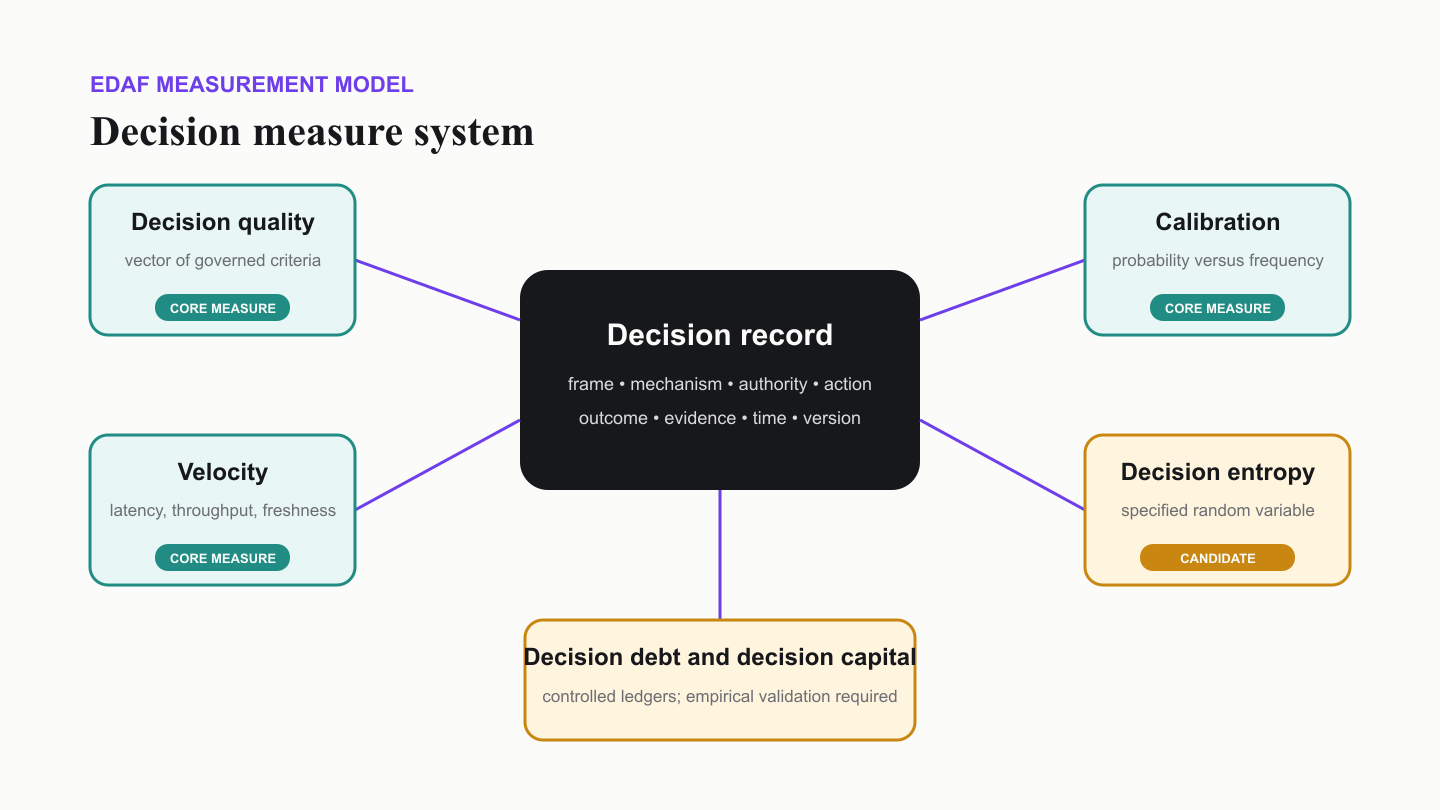
Decision qualityA vector of objective, constraint, evidence, process and outcome criteria.
Decision velocityElapsed time, throughput or freshness—defined for a particular decision context.
Decision debtA proposed measure of the future cost or risk created by deferred correction.Research construct
EDAF™ measurement model

Measure the decision from its record.

DecisionOne connects mechanism, authority, action, outcome, evidence, time and version. That record is the basis for quality, calibration and velocity measures.

EDAF™ diagram showing the decision record as the basis for decision quality, calibration, velocity and research measures
Next step

Make one consequential decision visible.

Book a Decision Discovery